01
Space
Sound establishes spatial relationships, allowing the listener to perceive an environment rather than simply hear individual events.

Cam Lasky · Spatial Practice
Designing perceived space through sound.
Developed by Cam Lasky for KWAIOTO, Sonic Architecture is a mutable spatial practice in which sound, image, text, movement, memory, and digital environments become materials for shaping perception. Each installation rebuilds the space in a different form.
Sonic Architecture is the practice of designing perceived space through sound.
It begins not with melody or rhythm, but with the listener's perception of space. Every sonic element exists because it transforms spatial experience.
It is not a fixed visual style, musical genre, or permanent container. Every work produces its own architecture, and every installation changes the form of the space itself.
Sonic Architecture Installations
Sonic Architecture is not a museum of completed works. It is a mutable space whose structure changes with every installation.
One work may take the form of an album, another of a virtual environment, a streamed performance, an audiovisual installation, or a physical space. The medium changes, but the central task remains the same: to organise perception as an inhabitable structure.
The installations are numbered not as a conventional catalogue, but as a record of the forms taken by this evolving space.
What is Sonic Architecture?
Sonic Architecture treats sound as a structural medium that shapes how space is perceived, experienced, inhabited, and remembered.
Sonic Architecture approaches sound as a means of constructing perceived space. Rather than beginning with musical form, it begins with the spatial relationship between the listener and the sonic environment.
Every sonic element serves a structural purpose. Rhythm, texture, silence, dynamics, resonance, and movement are organised to define spatial relationships, guide perception, and establish a coherent auditory environment.
Within this framework, sound is not treated as an isolated object but as part of a larger system. Individual sounds gain meaning through their relationships with one another, creating environments that can be experienced, navigated, and remembered.
Key Characteristics
Sonic Architecture is defined not by a musical style, but by a set of structural characteristics.
01
Sound establishes spatial relationships, allowing the listener to perceive an environment rather than simply hear individual events.
02
Every sonic and audiovisual element contributes to an overall architectural framework.
03
Perception changes continuously as sound, image, and duration unfold through time.
04
Perceived space is accumulated through repetition, transformation, absence, and return, allowing environments to remain recognisable beyond individual sounds.
05
The listener completes the architecture through experience, making perception an active part of the work rather than a passive response.
Why Architecture?
Sonic Architecture applies architectural thinking to the organisation of auditory and perceptual experience.
Architecture is not defined only by walls, roofs, or materials. It is defined by the organisation of relationships that shape how space is experienced.
Sonic Architecture extends this way of thinking into the auditory and audiovisual domain. Sound becomes the primary material through which perceived space is organised, while image, text, movement, duration, and environment can become part of the same structure.
Rhythm, texture, silence, resonance, movement, image, and duration function as architectural elements. Their significance emerges not in isolation but through the relationships they establish within a coherent spatial system.
The goal is not to imitate architecture, but to apply architectural thinking to the design of perception.
Design Process
Sonic Architecture develops through a sequence of conceptual, spatial, material, temporal, and perceptual decisions.
01
The process begins with a conceptual condition rather than a musical form. This may involve a philosophical question, a narrative structure, a spatial tension, or a model of perception.
02
A spatial framework is established to determine distance, scale, density, direction, enclosure, movement, access, obstruction, and passage within the environment.
03
Sound, silence, image, text, light, motion, noise, rhythm, resonance, and decay are selected according to their structural function.
04
Elements are organised through time to produce changes in position, pressure, scale, intensity, orientation, visibility, and attention.
05
Repetition, transformation, absence, and return are used to build memory. Earlier spatial conditions remain active in perception even after they have changed.
06
The work is evaluated not only by how individual materials function, but by how the complete environment is perceived, entered, navigated, inhabited, and remembered.
Current Languages
External and Quiet Tech Noir are opposing pressures within Sonic Architecture, not separate genres.
External Tech Noir
Impact, rhythm, density, and bodily movement make the hidden system physical. In ANGEL DOWN: ELAN, historical photography, literature, and present sound interfere to create a third Umwelt, a perceived world in Jakob von Uexküll's sense. In ANGEL DOWN: THE GAFF, co-created with Ayami Inokawa, breath and noise saxophone bring a body into that field of machine memory.
Quiet Tech Noir
Silence, stasis, erosion, duration, and spatial attention make perception itself structural. In THE UNWORTHY pt.1, violence remains below spectacle while the image survives as an unstable body.
Reconstruction Method
Fragments Shift System — FSS — is a sound-driven method for reconstructing photographic memory. The photograph is treated as a body rather than as an illustration.
Image fragments are divided, displaced, delayed, repeated, eroded, and rebuilt through frequency, pressure, duration, and silence. Sound does not decorate the image; it changes the conditions under which that image can continue to exist.
FSS crosses both intensities of Tech Noir: outward and physical in ANGEL DOWN, inward and restrained in THE UNWORTHY.
Applications
Sonic Architecture is not a genre. It is a spatial framework that can take different forms without losing its central method.
Albums, EPs, and individual compositions can function as designed auditory environments rather than collections of separate tracks.
Sound can reconstruct, extend, or destabilise cinematic space, creating environments that exist between image, memory, duration, and perception.
Sound, light, creative coding, architecture, and audience movement can be organised within real environments, allowing physical space itself to become part of the work.
Performance, streaming, and cross-reality formats can be designed as spatial experiences in which remote audiences inhabit a shared audiovisual environment.
Sonic Architecture Installations
The numbering records the forms taken by the space, not a fixed visual system or repeated format.

Installation No. 1
An eight-room Sonic Architecture installation built from prophecy, plague, perception, testimony, blindness, and hindsight. Rather than retelling the tragedy, the work constructs the invisible causal structure that makes it unavoidable.

Installation No. 2
Four perceptual rooms moving from voice to command, rule, and body. External Tech Noir turns pressure outward, while historical photography, literature, and present sound interfere through Fragments Shift System to create a third Umwelt.

Installation No. 2 · Second Movement
Cam Lasky, Ayami Inokawa
Four compositions in two tellings: four Original Mixes and four Ayami Inokawa ReTold versions. Electronic structures and sound-driven archival images meet the breath, friction, and noise of the saxophone, and a body enters the system.
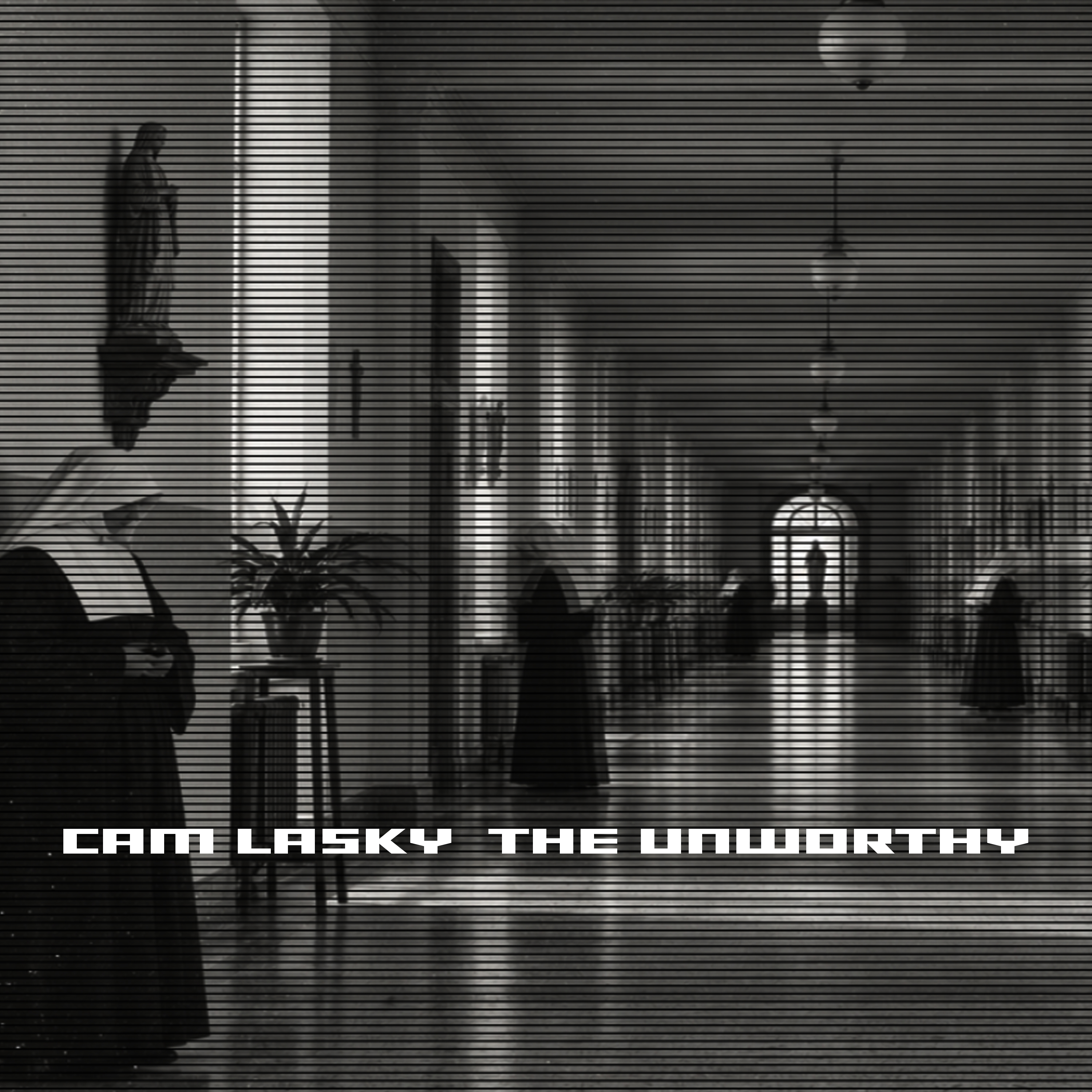
Installation No. 3
Four rooms built from faith, ordeal, identity, and collective fear. Quiet Tech Noir turns pressure inward as FSS treats photographic memory as a disciplined, fragmented, and resistant body.
Related Spatial Works
Cinestream Live
An audiovisual reconstruction of cinematic space in which industrial rhythm, machine memory, architecture, and moving image form a continuous perceptual environment.
The Essence
Sonic Architecture is not the design of sound.
It is the design of perception through sound.
Frequently Asked Questions
A concise reference for the definition, purpose, and application of Sonic Architecture.
Sonic Architecture is a mutable spatial practice developed by Cam Lasky for KWAIOTO. It uses sound as a primary structural medium while integrating image, text, movement, memory, digital space, and physical environment to shape perception.
No. Sonic Architecture is not a genre. It is a design framework that can be applied across recorded works, cinema, installation, live performance, streamed environments, XR spaces, and physical environments.
Sound design often focuses on the creation, treatment, or placement of individual sounds. Sonic Architecture focuses on the larger system of relationships through which an auditory and spatial environment is perceived, inhabited, and remembered.
The term refers to architectural thinking rather than the imitation of physical buildings. Sound and related media are organised through relationships of space, scale, structure, movement, density, duration, and perception.
Sonic Architecture was developed by Cam Lasky as a central spatial and perceptual practice for his work and for KWAIOTO.
Yes. Sonic Architecture can take the form of recorded works, audiovisual installations, cinema, live performance, streamed environments, XR spaces, and physical installations in which sound organises perception.
Further Reading
Explore the conceptual systems, artistic practices, and works connected to Sonic Architecture.
A perceptual and spatial approach to ambient techno developed within the wider KWAIOTO framework.
Enter THE UNWORTHY →A forceful, dance-oriented Tech Noir practice capable of operating within Sonic Architecture without surrendering physical impact.
Enter ANGEL DOWN: ELAN →A method for treating repetition, degradation, archive, and technological residue as forms of memory.
Read KWAIOTO Concept →Artist, producer, and founder of KWAIOTO, working across Tech Noir, Machine Memory, Sonic Architecture, cinema, and spatial practice.
Artist profile →